London, September 30 : Scientists have shown that it’s possible to make oil rigs or other ocean structures invisible to tsunami waves, with the help of an ‘invisibility cloak’.
Invisibility cloaks that are able to steer light around two dimensional objects have become reality in the last few years.
According to a report in New Scientist, the first real-world application of the theories that made them possible could be in hiding vulnerable coastlines and offshore platforms from destructive tsunamis.
Washington, September 30 : Commercial aquatic plants grown in constructed wetlands (CWs) are being touted as inexpensive, low-technology approaches for treating agricultural, industrial, and municipal wastewater to comply with increasingly stringent environmental regulations.
CWs, or marshes built to treat contaminated water, incorporate soil and drainage materials, water, plants, and microorganisms.
“Surface-flow” constructed wetlands resemble shallow freshwater marshes and generally require a large land area for wastewater treatment.
More effective for greenhouse and nursery operations with limited production space and expensive land are a type of constructed wetland called “subsurface flow”.
Washington, September 30 : Scientists have shown that it is possible to reduce carbon dioxide (CO2) using a relatively simple machine that can capture the trace amount of CO2 present in the air at any place on the planet.
The machine has been developed by a team of researchers from the University of Calgary (U of C) in Canada, lead by climate change scientist David Keith.
“At first thought, capturing CO2 from the air where it’s at a concentration of 0.04 per cent seems absurd, when we are just starting to do cost-effective capture at power plants where CO2 produced is at a concentration of more than 10 per cent,” said Keith, Canada Research Chair in Energy and Environment.
New Delhi, Sep 30 : Russia will start deliveries of MiG-29K Fulcrum-D carrier fighters to India in the spring of 2009.
Russia and India signed a contract on January 20, 2004, stipulating the delivery of 12 single-seater MiG-29K and four two-seater MiG-29KUB by 2009, to be deployed on the Admiral Gorshkov, currently being retrofitted in Russia for the Indian Navy.
“The first four MiG-29K aircraft will be delivered to India in the spring of 2009,” said Mikhail Globenko, marketing director of MiG.
Washington, September 30 : A new research has suggested that as seawater becomes more acidic because of carbon dioxide from the atmosphere dissolving in the oceans, an unexpected side effect is taking place in the form of sounds traveling farther underwater.
The research has been conducted by marine chemists at the Monterey Bay Aquarium Research Institute in California, US.
Conservative projections by the Intergovernmental Panel on Climate Change (IPCC) suggest that the chemistry of seawater could change by 0.3 pH units by 2050.
Keith Hester and his coauthors calculate that this change in ocean acidity would allow sounds to travel up to 70 percent farther underwater.
Washington, September 30 : In a discovery that is nothing less than astonishing, NASA’s Phoenix Mars Lander has detected snow falling from Martian clouds.
A laser instrument designed to gather knowledge of how the atmosphere and surface interact on Mars, detected snow from clouds about 2.5 miles above the spacecraft’s landing site.
Data show the snow vaporizing before reaching the ground.
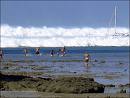 London, September 30 : Scientists have shown that it’s possible to make oil rigs or other ocean structures invisible to tsunami waves, with the help of an ‘invisibility cloak’.
 New Delhi, Sep 30 : Russia will start deliveries of MiG-29K Fulcrum-D carrier fighters to India in the spring of 2009.
 Washington, September 30 : In a discovery that is nothing less than astonishing, NASA’s Phoenix Mars Lander has detected snow falling from Martian clouds.

