Washington, March 27 : A new study by a Queen’s University Belfast academic has shown that crabs not only suffer pain but that they retain a memory of it.
The study, which looked at the reactions of hermit crabs to small electric shocks, was carried out by Professor Bob Elwood and Mirjam Appel from the School of Biological Sciences at Queen’s.
Professor Elwood, who previously carried out a study showing that prawns endure pain, said his research highlighted the need to investigate how crustaceans used in food industries are treated.
Washington, March 27 : Engineers at MIT (Massachusetts Institute of Technology), for the first time, have observed the initiation of a mass gathering and subsequent migration of hundreds of millions of fish.
The work, conducted using a novel imaging technique, "provides information essential to the conservation of marine ecosystems that vast oceanic fish shoals inhabit," according to the research team.
It also confirms theories about the behavior of large groups of animals in general, from bird flocks to locust swarms.
Until now, those theories had only been predicted through theoretical investigations, computer simulations and laboratory experiments.
Washington, Mar 27 : Scientists at Scripps Research Institute have uncovered the structure of a protein that makes cancer cells resistant to chemotherapy.
The protein, called P-glycoprotein or P-gp makes cancer cells resistant to chemotherapy drugs. The research team believes that the structure would help them design more effective drugs.
Washington, March 27: Scientists at Michigan State University have found that cholesterol crystals can disrupt plaque in a patient’s cardiovascular system, and thereby cause a heart attack or stroke.
George Abela, chief of the cardiology division in MSU’s College of Human Medicine, believes that the new finding may significantly change the way doctors and researchers approach cardiovascular attacks.
“Any time there is something completely new or unique in medical research, it is met with healthy skepticism. But we have found something that can help dramatically change how we treat heart disease,” said Abela, who has been working with cholesterol crystals since 2001.
Washington, March 27: In a new report, scientists have determined that nanoparticles in cosmetics, sunscreens, and hundreds of other personal care products may be harmful to the environment.
Their report was part of symposia that included almost two dozen papers at the 237th National Meeting of the American Chemical Society where scientists grappled to understand the environmental and human health effects of nanotechnology.
Washington, March 27 : Braunschweig Helmholtz researchers have found that an excessive immune response is responsible for the fatal outcome of influenza illnesses in mice.
The researchers have also found that this overreaction has genetic roots.
"Where there are many scientific works dealing solely with the flu virus, we have investigated how the host reacts to an infection," says Klaus Schughart, head of the Experimental Mouse Genetics research group.
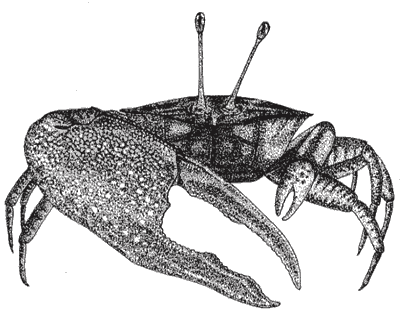 Washington, March 27 : A new study by a Queen’s University Belfast academic has shown that crabs not only suffer pain but that they retain a memory of it.
 Washington, Mar 27 : Scientists at Scripps Research Institute have uncovered the structure of a protein that makes cancer cells resistant to chemotherapy.
 Washington, March 27: In a new report, scientists have determined that nanoparticles in cosmetics, sunscreens, and hundreds of other personal care products may be harmful to the environment.
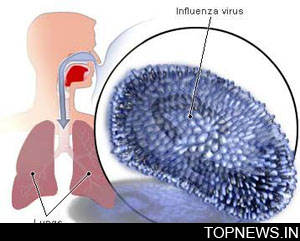 Washington, March 27 : Braunschweig Helmholtz researchers have found that an excessive immune response is responsible for the fatal outcome of influenza illnesses in mice.
