Washington, March 26 : New results from NASA's Chandra X-ray Observatory have suggested that a special class of black holes have a mechanism for regulating the rate at which they grow, and can shut off the high-speed jets they produce.
Some stellar-mass black holes launch powerful jets of particles and radiation, like seen in quasars, and are called "micro-quasars".
The new study looks at a famous micro-quasar in our own Galaxy, and regions close to its event horizon, or point of no return.
Washington, March 26 : While it is thought that men remain fertile throughout life as compared to women, Swedish researchers have now shown that a fertilising sperm can get help from the egg to rejuvenate.
Researchers at the Sahlgrenska Academy, University of Gothenburg, say that their finding is an important step towards future stem cell therapy.
The researchers highlight the fact that the risk of chromosomal abnormalities in the foetus is highly correlated to the age of the mother, but is nearly independent of the age of the father.
According to them, one possible explanation is that egg cells have a unique ability to reset the age of a sperm.
Washington, March 26 : In a new research, scientists have determined that as soot particles in the atmosphere age, airborne sulfuric acid may help turn them into condensation nuclei, which enable the formation of clouds.
The research was conducted by Alexei F. Khalizov and colleagues from Texas A and M University, who worked alongside researchers from University of Minnesota, and Lund University, Sweden.
Carbon soot aerosols from combustion of fossil fuels and forest fires directly influence the Earth-atmosphere heat balance by absorbing sunlight.
Washington, Mar 26 : By mapping the entire genome of a bacterium that infects a close relative of the fruit fly, scientists at Uppsala University have found that gene exchange is widespread among this sex-manipulating bacteria.
The finding paves the way for using sex-manipulating bacteria as environmentally friendly pesticides against harmful insects.
Washington, March 26 : In a new study, scientists have found that insects known as aphids can evade parasitic wasps by snuggling close to their dead comrades.
A parasitic wasp typically lays its eggs inside an aphid. After hatching, the young wasp eats the aphid from the inside out before breaking free and flying away.
Normally, when a non-predator, like a deer or a rabbit, encounters a bunch of dead animals, its instinct is to flee.
Washington, March 26 : Scientists have solved the mystery of arsenic-poisoning crisis in Asia, by discovering how arsenic enters the groundwater below the Himalayas.
Thousands of people in Bangladesh, Cambodia, India, Myanmar and Vietnam die of cancer each year from chronic exposure to arsenic, according to the World Health Organization.
 Washington, March 26 : New results from NASA's Chandra X-ray Observatory have suggested that a special class of black holes have a mechanism for regulating the rate at which they grow, and can shut off the high-speed jets they produce.
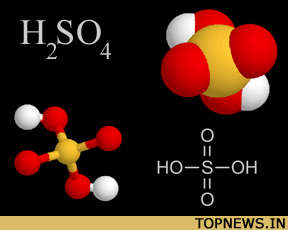 Washington, March 26 : In a new research, scientists have determined that as soot particles in the atmosphere age, airborne sulfuric acid may help turn them into condensation nuclei, which enable the formation of clouds.
 Washington, Mar 26 : By mapping the entire genome of a bacterium that infects a close relative of the fruit fly, scientists at Uppsala University have found that gene exchange is widespread among this sex-manipulating bacteria.
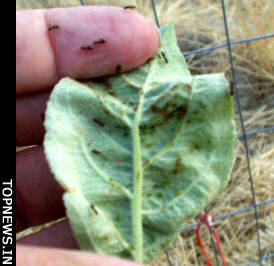 Washington, March 26 : In a new study, scientists have found that insects known as aphids can evade parasitic wasps by snuggling close to their dead comrades.
 Washington, March 26 : Scientists have solved the mystery of arsenic-poisoning crisis in Asia, by discovering how arsenic enters the groundwater below the Himalayas.
