LG Electronics India Share Price Target at Rs 1,925: Axis Direct
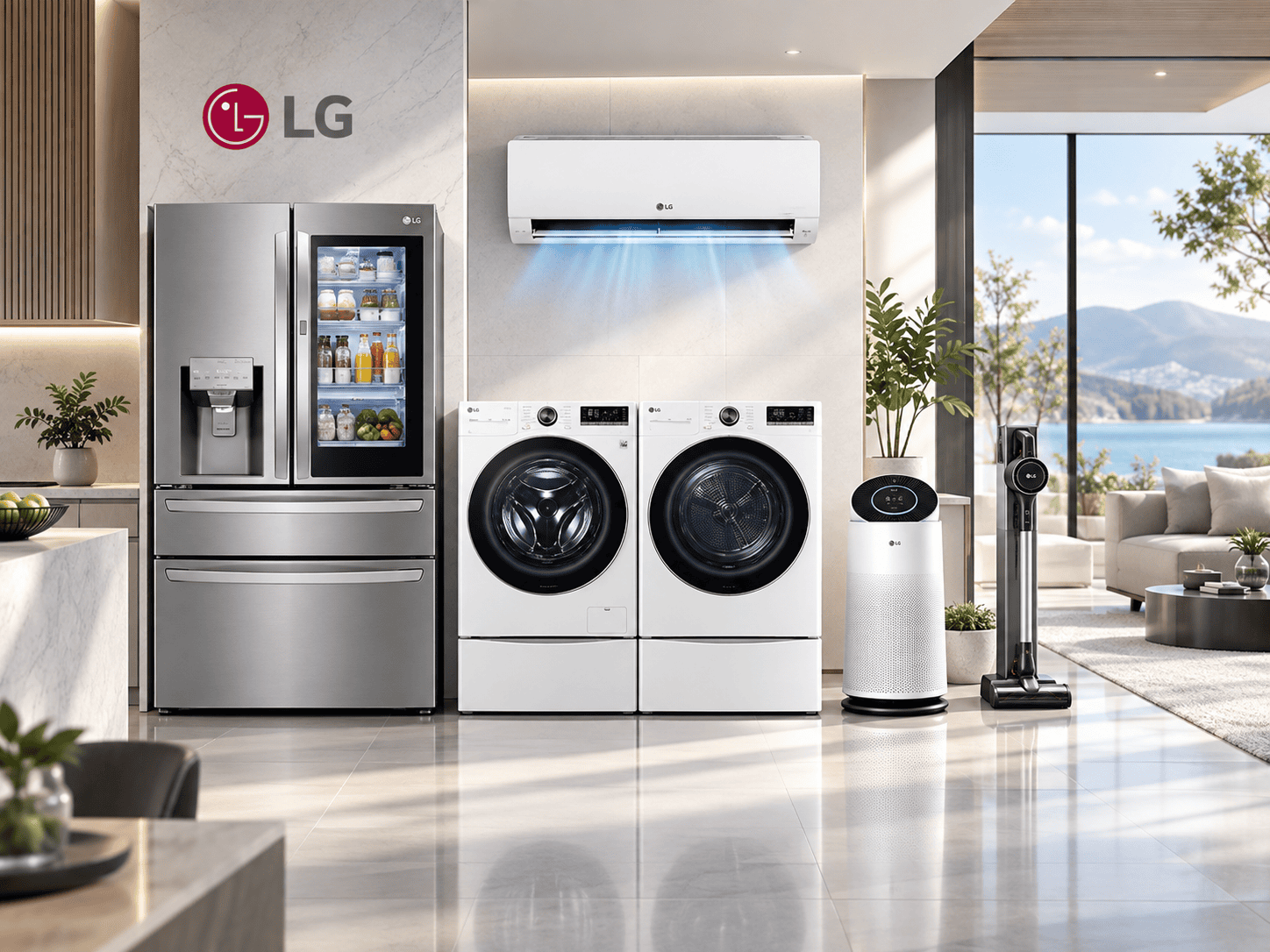
Axis Direct has reiterated its BUY call on LG Electronics India with an unchanged 12-month target of Rs 1,965, roughly 19 percent above the prevailing Rs 1,646. In a rare stumble, the market leader saw FY26 operating profit shrink about 23 percent to Rs 2,408 crore as steel, plastic and semiconductor costs, a weak rupee and heavy festive marketing squeezed margins from 13 percent to below 10 percent, even as revenue edged up 1 percent to Rs 24,605 crore. The brokerage reads the dip as cyclical, not structural, and expects margins to rebuild toward 13 percent by FY28 as input costs settle and localisation deepens. The balance sheet stays debt-free.
Axis Direct • Annual Report Analysis • Durable Goods BUY
LG India: a market leader poised for a margin rebound
Barely a year after a blockbuster market debut, the country's dominant appliance maker has weathered a costly patch of input inflation. Axis Direct argues the worst of the margin squeeze is passing, and that leadership plus a debt-free balance sheet set up the recovery.
A rare down year for a market leader
FY26 was, by LG India's own exacting standards, a difficult year. Revenue barely moved, inching up 1 percent to Rs 24,605 crore as a cooler-than-usual summer sapped air-conditioner demand, while the cost line did the damage. Raw materials — steel, plastics, semiconductors — turned dearer, the rupee slipped, and the company leaned into festive marketing; the upshot was that the cost of goods rose 4 percent even as sales crawled, gross profit slipped 4 percent and operating expenses climbed 8 percent. Operating profit consequently fell about 23 percent to Rs 2,408 crore, dragging the margin from 13 percent to under 10, and net profit contracted 24 percent to Rs 1,685 crore. The trajectory of that margin, and its expected repair, frames the entire thesis.
EBITDA margin • the FY26 dip and the road back (%)
10
13
10
13
13
FY24
FY25
FY26
FY27E
FY28E
TopNews chart, drawn from the house's own margin estimates; the FY26 trough (amber) is expected to give way to a return to 13 percent by FY28.
Two engines, one leader
LG India runs on two divisions. Home Appliances & Air Solution — refrigerators, washing machines, air conditioners, microwaves — is the workhorse, contributing about 73.8 percent of revenue at Rs 18,161 crore, and it holds the number-one offline position across nearly every category it competes in. Home Entertainment, chiefly televisions and commercial displays, chips in the remaining 26.2 percent at Rs 6,444 crore, anchored by a commanding lead in premium OLED sets. The revenue base has compounded steadily, with appliances retaining the lion's share even as both engines scale.
Revenue mix by division • Rs crore
Home Appliances & Air Solution Home Entertainment
21,352
24,367
24,605
27,868
31,006
FY24
FY25
FY26
FY27E
FY28E
TopNews chart, built from the house's segmental estimates; column height is total revenue, split by division.
The breadth of that leadership is unusual, and it is what lends the recovery its credibility.
| Category (offline) | Market share |
|---|---|
| Microwave ovens | 45.0% |
| Washing machines | 31.5% |
| Refrigerators | 28.8% |
| Inverter air conditioners | 18.7% |
| Room air conditioners | 16.2% |
| OLED televisions | 60%+ |
Building India into a global hub
The capital-expenditure programme is where LG India is playing its longest game. Its flagship project is a third manufacturing facility at Sri City in Andhra Pradesh — spanning nearly 10 lakh square metres and drawing an investment of Rs 5,000 crore funded entirely from internal accruals — slated to go live in Q3FY27, first for air conditioners and compressors, then washing machines and refrigerators. The Pune plant, meanwhile, was expanded to make 674-litre and 790-litre large-format refrigerators, sizes no other brand yet produces locally in India. Underpinning it all is a push to lift component localisation from 55.2 percent toward 70 percent over three to four years — the single most important lever for margins, and a natural hedge against a volatile rupee. Exports, already at Rs 1,269 crore across more than 50 countries, add a second layer of currency insulation.
What powers the next leg
Beyond the factory floor, the growth agenda is broad. Premiumisation is the first pillar, as Indian buyers trade up to French-door refrigerators, automatic washer-dryers and OLED screens, feeding LG's "mass to class" strategy. Regional penetration is the second: the new value-focused "Essential Series" targets under-served Tier-2, Tier-3 and rural markets, supported by 96 regional offices and easy consumer finance. Layered on top are a scaling B2B franchise in commercial HVAC and interactive displays — LG recently fitted its Multi-V systems at the Prime Minister's Office — an expanding export book under "Make-India-Global," and a nascent, high-margin aftermarket services business built around annual maintenance contracts and its LG Best Care programme. A milestone worth noting: the company sold more than 10 lakh room air-conditioner units in a single quarter for the first time.
The numbers
The estimates tell the recovery story in one glance: a sharp FY26 dip, then a brisk rebound as costs normalise and the new capacity comes on stream.
| Rs crore / ratio | FY25 | FY26 | FY27E | FY28E |
|---|---|---|---|---|
| Net sales | 24,367 | 24,605 | 27,868 | 31,006 |
| EBITDA | 3,110 | 2,408 | 3,483 | 4,031 |
| EBITDA margin (%) | 13 | 10 | 13 | 13 |
| Net profit | 2,203 | 1,685 | 2,600 | 2,841 |
| EPS (Rs) | 32 | 25 | 38 | 42 |
| P/E (x) | – | 70 | 45 | 41 |
| Return on equity (%) | – | 22 | 29 | 27 |
Risks worth weighing
Key risks flagged by the house
Input costs and currency. Swings in steel, plastic and semiconductor prices, and a weaker rupee, can compress margins — the very forces that dragged FY26.
Competition and technology cycles. Aggressive pricing and fast product churn by global and domestic rivals threaten share and risk inventory obsolescence.
Regulatory and e-waste norms. Frequent revisions to energy-star ratings, quality standards and producer-responsibility rules raise compliance and redesign costs.
Seasonal and weather risk. Cooler summers or unseasonal rain hit air-conditioner volumes, as an off summer did this year.
Supply chain and geopolitics. Shipping bottlenecks or component shortages could disrupt production schedules and inflate logistics costs.
Valuation and the target for investors
Axis Direct values LG India at about 47 times FY28 earnings of roughly Rs 42 a share, holding its target at Rs 1,965 for an upside near 19 percent. On trailing FY26 numbers the stock optically screens dear at some 70 times, but that multiple compresses to about 41 times by FY28 as profits recover — the crux of the bull case.
×
Rs 42FY28E EPS
=
Rs 1,965 target
For investors, the takeaway is a BUY with a Rs 1,965 objective, best accumulated on weakness within the Rs 1,300-to-1,756 band. This is a debt-free market leader — cash of more than Rs 4,476 crore, a return on capital near 29 percent — priced for a recovery that its localisation drive, new capacity and premiumisation tilt make credible. The number to watch is the gross margin: if input costs behave and localisation climbs toward 70 percent, the rebound to 13 percent operating margins should follow.
Sources
Research: Axis Securities (Axis Direct) Research. Analysts: Eesha Shah and Vishal Jagwani. Annual Report Analysis dated 10 September 2026. LG Electronics India listed on the exchanges in October 2025.
The margin-recovery plot and the revenue-mix columns are TopNews illustrations built entirely from the brokerage's own estimates; figures in Rs crore unless noted, and unit counts converted to lakh. Securities investments are subject to market risks; prices can fall as well as rise, past performance is no guide to future returns, and readers should consult a qualified adviser before acting.
TopNews Hindi
- FSSAI की शराब कार्रवाई: मैकडॉवेल्स नंबर 1, Old Monk, Antiquity Blue, Royal Challenge पर बैन
- Karuppu, Parasakthi, Thaai Kizhavi, Blast and Kara Among Best Tamil Movies for 2026
- Anupama, YRKKH, Vasudha, Tum Se Tum Tak: सबसे ज़्यादा देखे जाने वाले धारावाहिक
- 2026 FIFA World Cup Current Rankings and Betting Odds for Sports Betting Fans
- JEE Main 2026: Exam Dates, Eligibility, Syllabus जेईई मेन 2026 परीक्षा की तारीखें, योग्यता, सिलेबस

