Featured

Sensex falls below 10,000-mark, Rupee also at record low

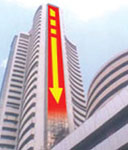
Sensex falls below 10,000-mark, Rupee also at record lowMumbai, Oct 23 : The benchmark Sensex tumbled by over 488 points and again dipped below the 10,000-mark in early trade on Thursday.
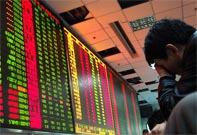
The Indian Rupee also hit a record low of 49.68 against the US dollar at the forex market.

Retail investors dumped stocks due to melting global stock markets and dismal quarterly results by some corporates.

The National Stock Exchange (NSE) index Nifty also tumbled by 147.05 points, or 4.13 per cent to 2,918.10.

Rajya Sabha sees the arrival of revised LLP Bill

With the motive to provide a new flexible business model for entrepreneurs and professionals engaged in trade, professional services and technology-based enterprises, a new and revised Limited Liability Partnership (LLP) Bill, 2008, was introduced by the government on Tuesday. The LLP Bill of 2006 gets replaced by this new-much awaited draft legislation.

In the Income-Tax Act, the tax structure of the new form of business would be addressed separately. Prem Chand Gupta the minister for corporate affairs, took the initiative to introduce the bill.

Why the world doesn''t seem a blur while running

Washington, Oct 23: No matter how fast we move or run, our eyes, head and body immediately adjust themselves according to our speed, and now scientists have uncovered the phenomenon underlying this unique ability, called vestibular-ocular reflex (VOR), in humans.

In their new study, researchers at the Salk Institute for Biological Studies explain how the vestibular-ocular reflex, which keeps us and the world around us stable, achieves the accuracy it is famous for.

The scientists said that signals from the vestibular system of the inner ear, which detects motion, are relayed in a linear fashion no matter how fast the neurons are firing, quite unlike other signals in the brain, whose transmission is frequency-dependent.

Reducing CEOs'' stock-option compensation can help limit risky investments

Washington, Oct 23 : A new University of Missouri study has found that decreasing option-based compensation of chief executive officers (CEOs) help in reducing risky investments.

After the recent credit crunch, people have criticised firms’ large executive pay packages.

In fact, John White, director of the Securities and Exchange Commission''s Division of Corporation Finance, has urged all U. S. companies to consider reduce compensation packages that reward excessive risk-taking by executives.

The new study provides evidence that decreasing stock option-based compensation of CEOs after companies'' earnings restatements leads to a decrease of risky investments and improved profitability.

Taiwan stocks shed 2.72 per cent on Wall Street's losses

Taiwan stocks shed 2.72 per cent on Wall Street's lossesTaipei - Taiwan's stocks closed 2.72 per cent lower amid a bearish sentiment triggered by Wall Street's sharp overnight losses as well as a dismal global and local economic outlook, dealers said.

The TAIEX index opened nearly 4 per cent lower in response to the overnight fall of Wall Street. Government funds moved by mid-morning to buy strongly, helping to somewhat ease the slide.

The index closed at 4730.51 points, a drop of 132.08 points or 2.72 per cent.

High-level Taiwan-China talks set for November 3 despite scuffle

Taipei - Taiwan and China are likely to hold second round of high-level talks in Taipei on November 3, despite a recent attack of a Chinese envoy by pro-independence activists during his visit to the island, a government source said on Thursday.

The Mainland Affairs Council, the island's top China policy planning body, was expected to hold a news conference at 4 p. m. (0800 GMT) in Taipei to announce that top China negotiator Chen Yunlin would arrive in Taiwan for the talks between November 3 and November 7, the source, who requested to remain anonymous, said.

Pages