Bangkok - A team of 30 Chinese and Thai scientists have launched a two-year joint research programme to study the impact of climate change on the monsoon variability - the annual rains that are key to regional rice production, media reports said Wednesday.
The joint research programme will investigate variability of the monsoon in the Indian Ocean and China and its likely impact on rice- growing in China, Thailand, Laos, Cambodia and Vietnam, The Nation newspaper reported.
San Francisco - Few lessons have been learned from Exxon Valdez, as oil spills are a regular occurrence 20 years after the worst ecological disaster in US history, environmentalists warned Tuesday.
On March 24, 1989, a massive tanker captained by a man who had allegedly been drinking, sailed outside regular Alaskan shipping lanes and hit a reef.
Washington - The crew of the International Space Station and space shuttle Discovery received a phone call from US President Barack Obama on Tuesday.
Obama made the call from the White House along with a group of school children and members of Congress, whom he described as just as excited as the kids to speak with astronauts. He said he was proud of the US astronauts, but also of the international cooperation in the building and operation of the space station.
Washington, Mar 24 : Researchers at University of Liverpool have shown how a single-celled organism, living freely in the environment, could be a source of Salmonella transmission to animals and humans.
Salmonella are microscopic living creatures that can contaminate almost any food type, causing diarrhoea, abdominal pain and fever.
Washington, March 24: Images taken by the cameras of NASA’s Cassini spacecraft have captured, for the first time, the shadows of Saturn’s moons cast onto its broad expanse of rings, which signals the approach of a phase known as equinox.
Like Earth and most of the other planets, Saturn’s spin axis is tilted relative to its motion around the Sun.
London, March 24 : A new study has discovered that some coral colonies can "live" for more than 4000 years, as old as the pyramids, smashing the previous lifespan estimates of 70 years, and showing that the animals grow far more slowly than was thought.
It is this extremely slow growth that is the secret of the corals' long life, Brendan Roark, at Texas A and M University, told New Scientist.
 Bangkok - A team of 30 Chinese and Thai scientists have launched a two-year joint research programme to study the impact of climate change on the monsoon variability - the annual rains that are key to regional rice production, media reports said Wednesday.
 San Francisco - Few lessons have been learned from Exxon Valdez, as oil spills are a regular occurrence 20 years after the worst ecological disaster in US history, environmentalists warned Tuesday.
 Washington - The crew of the International Space Station and space shuttle Discovery received a phone call from US President Barack Obama on Tuesday.
 Washington, Mar 24 : Researchers at University of Liverpool have shown how a single-celled organism, living freely in the environment, could be a source of Salmonella transmission to animals and humans.
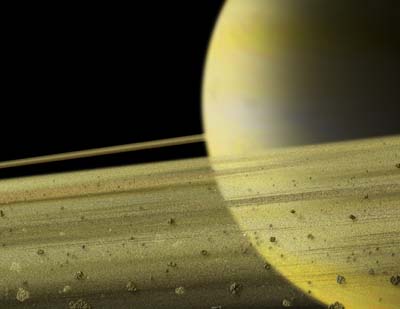 Washington, March 24: Images taken by the cameras of NASA’s Cassini spacecraft have captured, for the first time, the shadows of Saturn’s moons cast onto its broad expanse of rings, which signals the approach of a phase known as equinox.
 London, March 24 : A new study has discovered that some coral colonies can "live" for more than 4000 years, as old as the pyramids, smashing the previous lifespan estimates of 70 years, and showing that the animals grow far more slowly than was thought.
