Panvel Records 76% Price Growth as 42,330 New Homes Added: Mumbai Metropolitan Region Real Estate Report by ANAROCK Real Estate
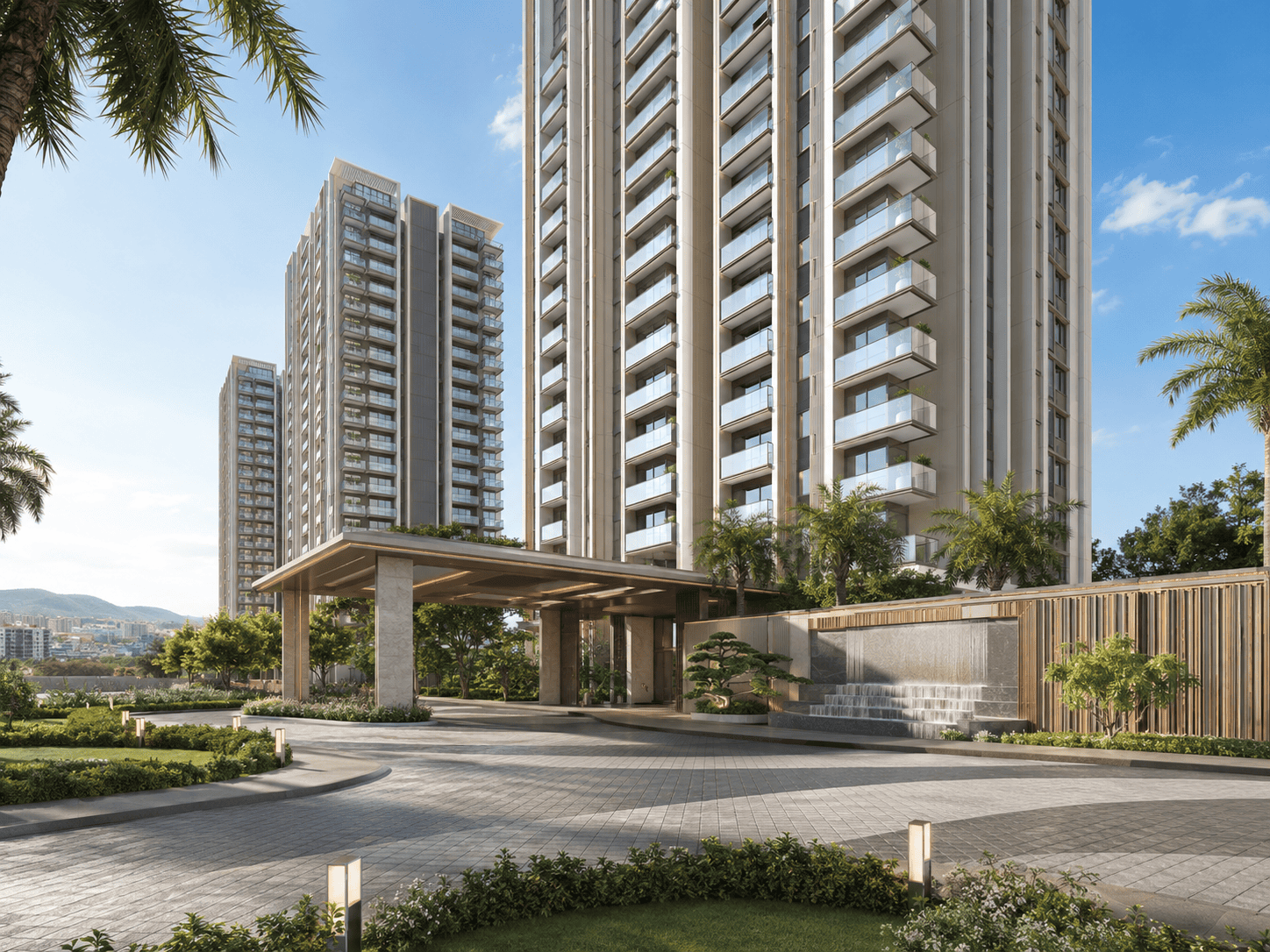
Panvel has shifted decisively from a peripheral Mumbai Metropolitan Region suburb into one of the region's most closely watched growth corridors, according to a new micro-market report from ANAROCK. The area's residential price index climbed to 176 by H1 2026, against a base of 100 in 2021 — outpacing Navi Mumbai's own index of 164 over the same stretch and translating into 76% price appreciation for Panvel homeowners. The market has simultaneously absorbed a wave of new supply, with 42,330 homes delivered between 2021 and H1 2026, even as 91% of current inventory remains under construction — a signal that developers are still betting heavily on the area's runway for growth.
|
Price Index Growth
+76%
|
Homes Supplied
42,330
|
Mid-Market Share
47%
|
Under Construction
91%
|
A Corridor Built on Connectivity
Panvel's positioning at the intersection of Mumbai, Navi Mumbai, Pune, and the Konkan region places it at the center of a rapidly expanding infrastructure and urbanization corridor. Connectivity through the Mumbai-Pune Expressway, the Sion-Panvel Highway, the Atal Setu sea bridge, Panvel Railway Junction, and emerging metro links has meaningfully improved the area's access to major employment and commercial districts across the wider region.
"The opening of Atal Setu and the operationalisation of Navi Mumbai International Airport have strengthened Panvel's investment narrative," said Dr. Prashant Thakur, Executive Director & Head of Research & Advisory at ANAROCK Group. He added that the market is increasingly benefiting from the convergence of residential demand, airport-linked employment, logistics activity, and planned mixed-use development.
Strong Supply, Focused Demand
Panvel's supply trajectory has been anything but linear. The market recorded sharp growth in residential launches between 2021 and 2023, with supply increasing 211% in 2022 and a further 261% in 2023, before registering a -7% decline in 2024 as the pace of launches moderated. Panvel's share of Navi Mumbai's total residential supply rose from 28% in 2021 to 46% in 2024, before easing to 42% in 2025 — still a substantial expansion in the market's relative weight within the broader Navi Mumbai housing landscape.
"The supply composition is that of a classic end-user and mid-income market," Dr. Thakur said, noting that homes priced between Rs 50 lakh and Rs 1 crore accounted for 47% of launches between 2021 and H1 2026, while 1 BHK and 2 BHK homes together made up 85% of total supply. That configuration mix suggests developers have continued to prioritize relatively accessible homes aimed at first-time buyers, young professionals, and nuclear families rather than chasing the luxury segment.
What Homes Cost — and Rent For — in Panvel
| Configuration | Size Range | Avg. Ticket Price | Indicative Monthly Rent |
|---|---|---|---|
| 1 BHK | 350-550 sq ft | Rs 52-82 lakh | Rs 13,000-18,000 |
| 2 BHK | 550-750 sq ft | Rs 82 lakh - Rs 1.12 crore | Rs 20,000-25,000 |
| 3 BHK | 750-1,050 sq ft | Rs 1.12-1.56 crore | Rs 30,000-35,000 |
Figures represent average ranges and can vary by project, location, furnishing, building age, and amenities. Notably, 1 BHK units alone represented 43% of total supply during the review period, with 2 BHK homes close behind at 42% — together underscoring how firmly the market is oriented toward first-time buyers and smaller households.
Appreciation Outpaces Navi Mumbai
Panvel's residential price index reaching 176 against Navi Mumbai's 164 — both measured against a 2021 baseline of 100 — indicates materially stronger appreciation in Panvel than in the broader Navi Mumbai market over the same review period. The report attributes that outperformance to a combination of infrastructure delivery, improving regional accessibility, and rising development activity, all of which have fed directly into buyer demand and, in turn, pricing power for developers.
The report is careful to flag a potential affordability challenge alongside the growth story: rising residential land prices and construction costs could put pressure on future price points and limit access for some buyers, particularly in a market whose current strength rests heavily on its appeal to price-sensitive, first-time purchasers.
Infrastructure Drives Repricing
Panvel's growth story is inseparable from a dense pipeline of infrastructure investment. The market is supported by the 22-km Atal Setu, the Panvel-Karjat rail corridor, Navi Mumbai Metro Line 2, the proposed Mumbai Metro Line 8 connection to Navi Mumbai International Airport, and the wider Alibaug-Virar Multimodal Corridor. The report places the combined value of delivered and under-construction infrastructure projects at more than Rs 2.40 lakh crore, spanning over 1,625 km of projects.
"The airport is emerging as the most significant catalyst," Dr. Thakur said, noting that it will support demand for aviation, logistics, hospitality, retail and commercial space. The proposed 667-acre Aerocity is positioned to create an integrated ecosystem around the airport, with CIDCO's master-planning process earmarking nearly 123 acres each for residential, commercial, and retail development within that framework. The report separately identifies FedEx's automated cargo hub and CIDCO's Integrated Logistics Park as factors expected to reinforce Panvel's warehousing, industrial, and logistics positioning going forward.
A Confident — and Concentrated — Construction Pipeline
Under-construction projects dominate Panvel's current residential inventory. As of H1 2026, 91% of available inventory was under construction, while only 9% was ready to move in — a split that underscores both the depth of the market's future supply pipeline and developers' evident confidence in sustained demand. More broadly, more than 6,400 acres of land were transacted across the Panvel catchment over the past five years, reflecting the scale of capital already committed to the corridor.
For homebuyers, that structure creates both opportunity and risk. Under-construction projects may offer newer amenities and staged payment plans, but buyers are advised to weigh delivery schedules, regulatory approvals, construction progress, developer track record, and project-level connectivity before committing capital. The report itself cautions that infrastructure delays, regulatory approvals, macroeconomic uncertainty, and affordability constraints could moderate the market's pace of growth going forward.
The Emerging Urban Ecosystem
Panvel's growth is also being supported by an expanding social-infrastructure base, including schools, colleges, hospitals, malls, recreational facilities, and railway connectivity. Integrated townships and gated communities are expected to add further residential, retail, and community infrastructure, helping the market evolve toward more self-sustaining neighborhoods rather than remaining a purely commuter-driven suburb.
"Panvel's long-term outlook will depend on whether employment generation keeps pace with housing delivery," Dr. Thakur said in summing up the report's findings. Airport operations, logistics, industrial activity, commercial development, and improved rail and metro connectivity could all help create that balance, he noted — and if that growth materializes as planned, Panvel stands to consolidate its position as one of the Mumbai Metropolitan Region's most important infrastructure-led residential and mixed-use corridors.
ANAROCK Group — Micro Market Report: Panvel & Navi Mumbai, MMR.
Figures reflect the report's stated review period (2021 to H1 2026) and are subject to revision. This article is for informational purposes only and does not constitute investment advice; prospective buyers should conduct independent due diligence before committing capital.
TopNews Hindi
- भारतीय क्रिकेट टीम बनाम इंग्लैंड क्रिकेट टीम के आंकड़े एवं टाइमलाइन
- FSSAI की शराब कार्रवाई: मैकडॉवेल्स नंबर 1, Old Monk, Antiquity Blue, Royal Challenge पर बैन
- Karuppu, Parasakthi, Thaai Kizhavi, Blast and Kara Among Best Tamil Movies for 2026
- Anupama, YRKKH, Vasudha, Tum Se Tum Tak: सबसे ज़्यादा देखे जाने वाले धारावाहिक
- 2026 FIFA World Cup Current Rankings and Betting Odds for Sports Betting Fans

