Science News

Hubble captures quadruple Saturn moon transit

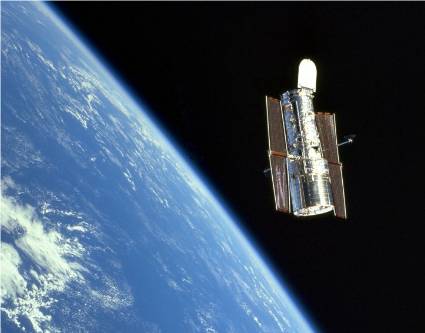
Hubble captures quadruple Saturn moon transitWashington, March 18: The Hubble Space Telescope has taken a photo of four moons of Saturn passing in front of their parent planet, in a rare moon transit.

In this view, the giant orange moon Titan casts a large shadow onto Saturn’s north polar hood.

Below Titan, near the ring plane and to the left is the moon Mimas, casting a much smaller shadow onto Saturn’s equatorial cloud tops.

Female mammals use their noses to choose right mates

Washington, march 18 : While female birds are known to choose their mates based on fancy feathers, a new study suggests that female mammals are more likely to follow their noses to the right mate.

Cambridge zoologist Tim Clutton-Brock and Harvard researcher Katherine McAuliffe point out that it is generally thought that mate choice plays a smaller role in mammals than in birds because vivid examples of female preferences-such as the ornate tails of peacocks that emerged because peahens prefer to mate with males that have showy plumage-are harder to find in mammals.

However, they say, female mating preferences are likely to be just as important in mammals, though they may not be as obvious to human observers.

Discovery prepares to rendezvous with space station

Discovery prepares to rendezvous with space station Washington  - The space shuttle Discovery was nearing the International Space Station for a planned docking later Tuesday.

The Discovery is to deliver the fourth and final solar panel to the International Space Station on a construction mission that will enable it to double the size of its crew to six astronauts. Three spacewalks are planned to install the solar panels and conduct other construction projects.

The mission will also deliver Japanese astronaut Koichi Wakata, who is slated to join the permanent crew on the orbiting space station.

Evidence of salt water found on Mars, scientists say

Evidence of salt water found on Mars, scientists say Washinton - A group of scientists who worked on the Phoenix Mars lander last year say they have found evidence of liquid salt water on the red planet.

An analysis of photographs from the lander that explored Mars for six months shows drops of what could be salty, liquid water on the legs of the lander.

They believe the droplets were kicked up from just below the planet's surface when Phoenix landed in May and say they grew and merged over time much as water particles would do.

Russia's launches European gravity probe

Russia's launches European gravity probeMoscow - Russia successfully sent into orbit Tuesday one of the European Space Agency's (ESA) most advanced missions to date that aims to map the Earth's gravity field, the Russian Space Forces said.

Spokesman Lieutenant-Colonel Alexei Zolotukhin was quoted by Russian news agencies as saying the satellite took off on the back of modified Russian ballistic missile at 1421 GMT from the Plesetsk Cosmodrome in north-west Russia.

"Approximately 1.5 hours after its start, the satellite will already be on its second lap around the Earth," Zolotukhin told Interfax.

Indian scientists find three new bacteria in stratosphere

Bangalore, Mar 17 (ANI): Indian scientists have discovered three new species of bacteria, which are not found on earth and highly resistant to ultra violet radiation.

These new micro-organisms were found in the upper stratosphere.

The species have been named as Janibacter Hoylei, Bacillus Isronensis and Bacillus Aryabhata respectively.

According to the Indian Space Research Organisation (ISRO), a balloon experiment was conducted using 26.7 million cubic feet balloon carrying a 459 kilograms scientific payload soaked in 38 kilograms of liquid neon.

The payload consisted of a cryosampler containing 16 evacuated and sterilised stainless steel probes.

Pages