Artificial black hole in lab generates Hawking Radiation
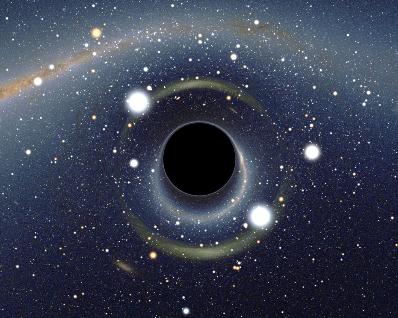 Washington, March 13: The first signs of “Hawking Radiation” - an effect that British physicist Stephen Hawking had predicted 30 years ago, has emerged from the simulated edge of a black hole.
Quantum mechanics says that entangled pairs made up of a particle and its antiparticle can spontaneously pop out of otherwise empty space, exist for a fleeting moment, and then annihilate each other and disappear.
In the 1970s, Hawking predicted that if such a pair was created near a black hole’s event horizon, one of its members might fall into the black hole before it could be annihilated.
The partner left stranded outside the event horizon would appear to an observer to have been radiated from the black hole. This particular radiation is called the “Hawking Radiation”.
Because it’s tough to see what’s going on around real black holes, physicists have tried to test the prediction for Hawking Radiation by trying to create artificial event horizons in their labs.
One promising way to mimic a black hole is to use a super cooled substance known as a Bose-Einstein condensate (BEC). If one region of the BEC is manipulated to move faster than the speed of sound, then sound waves traveling through the rest of the substance would not be able to keep up, effectively becoming trapped behind an event horizon.
Hawking radiation should show at this boundary as the production of particle-like packets of vibrational energy called phonons.
Now, Iacopo Carusotto at the University of Trento in Italy and his colleagues claim to have seen just that in a computer simulation of a BEC.
Their model shows that phonons do appear at the event horizon – and that one member of the pair falls into the “black hole” while the other remains outside as predicted.
Until now, researchers studying the way BECs should behave have used approximate calculations based on the equations used to analyse real black holes. Carusotto’s team, by contrast, did not assume any similarities to black holes.
“In this way, our observations can be considered as the first independent proof of the existence of Hawking radiation,” the researchers said.
According to Ralf Schützhold, an authority on artificial black holes at Dresden University of Technology in Germany, the group’s simulation will help experimenters spot the signature of such an event.
“Until now, we did not know a good way to measure entangled phonons, but the density signature that the group has found will help,” he said. (ANI)

