Technology Sector

Climate change opens new avenue for spread of invasive plants

Washington, Nov 20 : A new research by a team of scientists has suggested that climate change can open new avenues for spread of invasive plants.

The team’s findings indicate that certain plants could become invasive if they spread to places that were previously too cold for them.

“This paper is the first to suggest that the mechanisms that aid invasive species when they move from one continent to the next may actually work within continents when climate change gradually extends the distributional range of a species,” said Koen J. F. Verhoeven, an evolutionary biologist at The Netherlands Institute of Ecology.

“Plants may be able to outrun, so to speak, their enemies from the southern range,” he added.

Global warming predictions may be overestimated

Washington, Nov 20 : A detailed analysis of black carbon, in computer climate models, has suggested that those models may be overestimating global warming predictions.

Savanna fires occur almost every year in northern Australia, leaving behind black carbon, which is the residue of burned organic matter that remains in soil for thousands of years.

A new study, by researchers at Cornell University, quantified the amount of black carbon in Australian soils and found that there was far more than expected, according to Johannes Lehmann, a Cornell professor of biogeochemistry.

As a result of global warming, soils are expected to release more carbon dioxide, the major greenhouse gas, into the atmosphere, which, in turn, creates more warming.

Exploring the deep sea can benefit biomedical research

Washington, Nov 20 : A new study has highlighted how the exploration of the ocean depths can benefit humankind in the field of biomedical research.

Many marine organisms such as sea anemones and corals produce fluorescent proteins, which come in a variety of dazzling hues.

Fluorescent proteins have revolutionized biomedical research by enabling the imaging of processes within living cells and tissues.

The impact of this technology is considered so high that the 2008 Nobel Prize in Chemistry was most recently awarded to scientists that discovered and further developed the first green fluorescent protein that was applied as cellular marker.

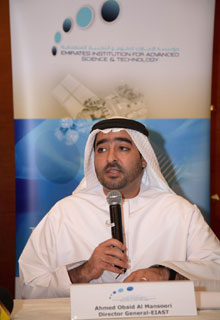
EIAST Proposes the Formation of a National Authority for Science '&' Technology

Ahmed Obaid Al MansooriDubai, 20th Nov.

Google iPhone voice-recognition doesn''t understand British accents

Google iPhone voice-recognition doesn''t understand British accentsLondon, Nov 19 : British iPhone users are facing a tough time using the new voice recognition software, because it does not understand British accents.

The new Google iPhone gives its users an opportunity to search for information using voice-recognition.

The high-tech programme was launched this week and allows users to search Google for cinema times, bring up pictures and information and convert

currency and measurements with one tap of the screen.

The miseries of 18th century''s toothache sufferers!

London, Nov 19 : In case the modern-day dentistry makes you wince, spare a thought for the toothache sufferers of the 18th century.

According to a rare book about the dental techniques of the period, even those treated by the most eminent practitioners were in for an agonising time.

Written in 1770 by Thomas Berdmore, who was considered to be the outstanding dentist in England, ''A Treatise on the Disorders and Deformities of the Teeth and Gums and the Most Rational Methods of Treating Them'' provides an insight into tortures endured by our forbears.

Berdmore, who was a dentist to King George III, has written about a 23-year-old woman left in a ''terrible state'' by a ''barber dentist''.

Pages