Science News
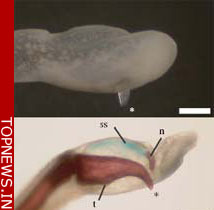 Washington, April 21: In new discoveries by researchers from Uppsala, Cambridge and Duke Universities, it has been shown that the earliest backboned land animals had different life histories.
 Soot or black carbon from mud cooking stoves, used in tens of thousands of villages in India, are turning out to be one of the main causes of global warming - says one of the world's leading climate scientists, Veerabhadran Ramanathan. According to a study by Ramanathan, Soot, the second most pernicious gas, after carbon dioxide, is causing 18 percent of the global warming, while carbon dioxide is responsible for 40 percent of carbon dioxide.
 Washington, April 21: Astronomers, using different telescopes, have found that the well-known Great Nebula of Orion, which is a stellar nursery of sorts, is a lively and overcrowded place, with young stars emitting gas jets in all directions, creating quite a chaotic picture.
 Berlin, April 21 : Scientists from the Max Planck Institute for Radio Astronomy in Bonn, Germany, Cornell University, USA, and the University of Cologne, Germany, have detected two of the most complex molecules yet discovered in interstellar space: ethyl formate and n-propyl cyanide.
 Washington, April 21 : Distracting consumers from a decision for some moments could help them make more accurate product evaluations, a new study suggests.
TopNews Hindi
- FSSAI की शराब कार्रवाई: मैकडॉवेल्स नंबर 1, Old Monk, Antiquity Blue, Royal Challenge पर बैन
- Karuppu, Parasakthi, Thaai Kizhavi, Blast and Kara Among Best Tamil Movies for 2026
- Anupama, YRKKH, Vasudha, Tum Se Tum Tak: सबसे ज़्यादा देखे जाने वाले धारावाहिक
- 2026 FIFA World Cup Current Rankings and Betting Odds for Sports Betting Fans
- JEE Main 2026: Exam Dates, Eligibility, Syllabus जेईई मेन 2026 परीक्षा की तारीखें, योग्यता, सिलेबस

