Flexible colour monitors and "heads-up" displays in car windshields may soon be a reality
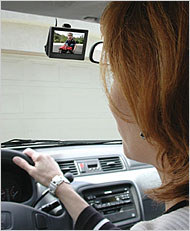 Washington, April 1: E-paper, flexible colour monitors, and "heads-up" displays in car windshields may soon be a reality, for engineers have already made the first "active matrix" display using a new class of transparent transistors and circuits.
The researchers say that they used nanowires, about a thousand times thinner than a human hair, to develop the display containing organic light emitting diodes (OLEDS) — devices that rival the brightness of conventional pixels in flat-panel television sets, computer monitors, and displays in consumer electronics.
"This is a step toward demonstrating the practical potential of nanowire transistors in displays and for other applications," said David Janes, a researcher at Purdue University's Birck Nanotechnology Center, and a professor in the School of Electrical and Computer Engineering.
The researchers say that their nanotechnology-based active-matrix display is similar to those in television sets and computer monitors, and that it is able to precisely direct the flow of electricity to produce video because each picture element (pixel) possesses its own control circuitry.
"We've shown how to fabricate nanowire electronics at room temperature in a simple process that might be practical for commercial manufacturing," said Tobin J. Marks, the Vladimir N. Ipatieff Research Professor in Chemistry in Northwestern's Weinberg College of Arts and Sciences, and a professor of materials science and engineering.
In their research paper published in the journal Nano Letters, the researchers write that as compared to conventional computer chips called CMOS, the nanowire thin-film transistors can be produced less expensively under low temperatures, something that makes them ideal to incorporate into flexible plastics that would melt under high-temperature processing.
The researchers also say that OLEDS eliminate the need to backlight the screen, as in the case of flat-panel televisions and monitors, making it possible to create more vivid displays that are thin and flexible.
They envision the application of the technology in antennas that aim microwave and radio signals more precisely than current antennas.
Such antennas may improve cell phone reception, and make it more difficult to eavesdrop on military transmissions on the battlefield, add the researchers.
The OLEDS consist of the transistors, electrodes made of a material called indium tin oxide and plastic capacitors that store electricity. All of the materials are transparent until activated to emit light.
"This could enable applications such as GPS navigational displays right on the windshield of your car. Imagine having a local map displayed on your windshield so that you didn't have to take your eyes off the road," Janes said.
"Even in this first demonstration, we are fairly close to the brightness you'd see in an LCD (liquid-crystal display) television," Janes added.
The researchers also said that they could create OLEDS of the proper size for commercial displays, about 176 by 54 microns, which would be ideal for small displays in cell phones, personal digital assistants and other portable electronics. (ANI)
TopNews Hindi
- FSSAI की शराब कार्रवाई: मैकडॉवेल्स नंबर 1, Old Monk, Antiquity Blue, Royal Challenge पर बैन
- Karuppu, Parasakthi, Thaai Kizhavi, Blast and Kara Among Best Tamil Movies for 2026
- Anupama, YRKKH, Vasudha, Tum Se Tum Tak: सबसे ज़्यादा देखे जाने वाले धारावाहिक
- 2026 FIFA World Cup Current Rankings and Betting Odds for Sports Betting Fans
- JEE Main 2026: Exam Dates, Eligibility, Syllabus जेईई मेन 2026 परीक्षा की तारीखें, योग्यता, सिलेबस

