Merkel's party keeps European lead despite coalition losses
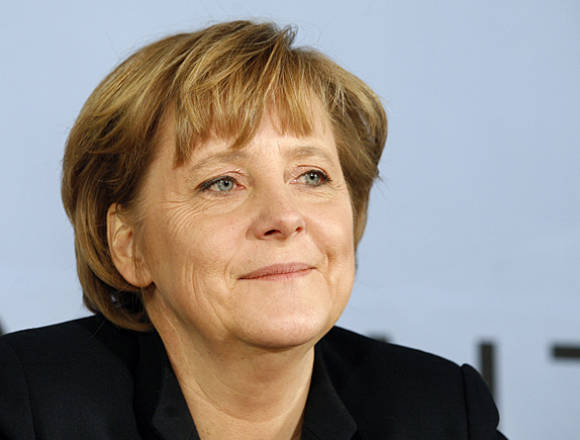 Berlin - Chancellor Angela Merkel's party topped the European Parliament election poll in Germany on Sunday, while her coalition partners, the Social Democrats (SPD), fared worse than expected in a vote seen as a dry-run for September's general election.
Merkel's Christian Democrat alliance (CDU/CSU) took 37.9 per cent of the poll, according to provisional results from the Federal Election Commission.
The SPD failed to lift their share of the European vote from their all-time low in 2004, coming in on Sunday at 20.8 per cent.
Both parties lost votes on their 2004 tallies to the opposition, with the liberal FDP and socialist Left parties making ground. The CDU/CSU alliance lost 6.6 per cent on their previous European total of 44.5 per cent.
Sunday's biggest gains were recorded by the FDP, who achieved double-digit figures in a European Parliament vote for the first time, climbing 4.9 percentage points to 11 per cent.
Voter participation lay at 43 per cent, matching turnout in 2004 and allaying fears of a continuing a downward trend.
The European election campaign in Germany was overshadowed by domestic debate over state-funded rescue packages for ailing banks and key industry players such as carmaker Opel.
Voter assessment of Merkel and her government's handling of the global financial crisis has also shaped recent opinion polls.
Leading figures within the SPD were plainly beginning a process of soul-searching after the poll.
"It is a disappointing result, there is no other way of putting it," said German Vice-Chancellor Frank-Walter Steinmeier of the SPD.
The SPD had been expected to improve on its historic low of 21.5 per cent in the last European election held in 2004, when internal party politics had led to deep unpopularity.
Instead, the party dropped a further 0.7 per cent.
SPD General Secretary Hubertus Heil said "we didn't manage to mobilize our voters," but suggested that the outcome would be different in the September general election.
For the CDU, despite their losses, the vote seemed to augur well for the general election due on September 27.
The party's general secretary Ronald Pofalla said that the vote proved his party was "by far the strongest political force in Germany."
In third place were the Greens, with 12.1 per cent, a tiny increase of 0.2 per cent on their 2004 performance.
The liberal FDP were keen to trumpet their double-digit result with an eye to coalition-forming come September.
"No party has gained as much as we have," said FDP leader Guido Westerwelle, of their upswing - which would make them an attractive coalition partner for Merkel's CDU.
The Left Party experienced a marginal increase, to 7.5 per cent. The Left were the only major party in Germany to oppose the Lisbon Treaty, having brought a case before the German constitutional court to prevent its ratification.
The CSU, which only runs in Bavaria, had no problems clearing the national 5-per-cent hurdle for representation in Europe, coming in at 48.1 per cent of the vote in Bavaria, which translated to 7.2 per cent of the national vote.
The party, which lost their overall majority in Bavaria for the first time during regional elections in 2008, claimed the European vote as their return to primacy.
"The CSU is back," said party leader Horst Seehofer in Munich.
Germany, the most populous state in the European Union, is apportioned 99 of the seats in the European Parliament. (dpa)

