Wellington - New Zealand awoke Sunday to the prospect of a new centre-right government to steer the country out of its worst recession for years after a general election dumped the Labour-led coalition that had ruled since 1999.
Saturday's election produced a sharp jump to the right, leaving prime minister-elect John Key, 47, leader of the conservative National Party, and his free market allies in the ACT party, to govern for the next three years.
Berlin - Separating three protesters from a German railtrack was slow work Saturday for a team of police after the anti-nuclear activists used an ingenious method to lock themselves in place.
During the morning, the two men and a woman fixed their hands and arms inside tubes inside a huge lump of concrete under the track, according to fellow protesters.
A trainload of nuclear waste was unable to pass along the line. Obstructing tracks is one way the anti-nuclear movement shows its opposition to the transport of waste.
Abuja - Decrying a return to fighting in the east of the Democratic Republic of Congo, German President Horst Koehler Saturday urged all African nations to put an end to their disputes.
"This must have an end," said Koehler, speaking at the German- sponsored fourth Africa Forum in the Nigerian capital of Abuja. He said the news from DR Congo was "particularly disappointing."
As the forum met, the leaders of DR Congo and Rwanda were at a meeting in Kenya to try to negotiate an end to the fighting in eastern DR Congo.
 Wellington - New Zealand awoke Sunday to the prospect of a new centre-right government to steer the country out of its worst recession for years after a general election dumped the Labour-led coalition that had ruled since 1999.
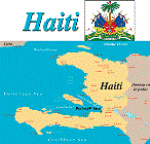 Port-au-Prince
  Milan - Torino edged visiting Palermo 1-0 Saturday in a pulsating game that opened the 10th round of Seria A at Turin's Stadio Olimpico.
 Brussels - Former world champion Tom Boonen on Saturday escaped uninjured after being involved in a car accident en route to the Brussels airport.
 Berlin - Separating three protesters from a German railtrack was slow work Saturday for a team of police after the anti-nuclear activists used an ingenious method to lock themselves in place.
 Abuja - Decrying a return to fighting in the east of the Democratic Republic of Congo, German President Horst Koehler Saturday urged all African nations to put an end to their disputes.
