Astronomers take first-ever photos of a distant solar system
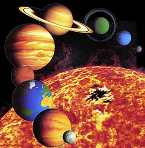 Washington - Scientists have taken the first-ever images of a multi-planet solar system orbiting a distant star.
The findings, published online Tursday by the journal Science Express, show three planets orbiting a star called HR8799, about 130 light years from Earth and 1.5 times the size of the Sun.
Though scientists have found about 200 such distant planets in the last decade, all have been detected through indirect techniques, such as measuring gravitational influence on the star being orbited.
"Every extrasolar planet detected so far has been a wobble on a graph. These are the first pictures of an entire system," Bruce Macintosh, an astrophysicist and one of the report's authors, said in a statement. "We've been trying to image planets for eight years with no luck, and now we have pictures of three planets at once."
The photos were snapped with high-contrast, near-infrared adaptive optics on the Keck and Gemini telescopes in Hawaii. They were first spotted in October 2007.
The planets are much farther from their star than Earth is from the Sun and are vastly larger - seven to 10 times as large as Jupiter, while the star itself is younger and brighter. The star is faintly visible to the naked eye on Earth, in remote regions far from city lights or with an amateur telescope.
Scientists expect additional, smaller planets in the same solar system that may be obscured by a large dust disk surrounding the star.
"I think there's a very high probability that there are more planets in the system that we can't detect yet," Macintosh said. "One of the things that distinguishes this system from most of the extrasolar planets that are already known is that HR8799 has its giant planets in the outer parts - like our solar system does - and so has 'room' for smaller terrestrial planets far beyond our current ability to see in the inner parts."
The planets are about 60 million years old, young by planetary standards, and are still "glowing" with heat from their formation, scientists said. (dpa)

