UN chief says G8, MEF deal on climate change "not sufficient"
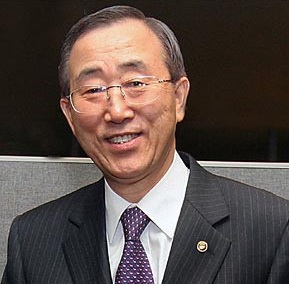 New York - The deal reached by the world's richest nations to limit global warming to within 2 degrees centigrade by 2050 is "not sufficient," and should be backed by medium-term measures to prevent the catastrophic impact of climate change, UN Secretary General Ban Ki-moon said Thursday.
"The commitments expressed today at the G8 and Major Economies Forum (MEF) leaders' meeting, while welcome, are not sufficient," Ban said in a statement. "Much more needs to be done if governments are to seal the deal on a new climate agreement in December in Copenhagen."
"The countries represented at L'Aquila are responsible for more than 80 per cent of global emissions, and that is why they bear special responsibility for finding a solution to the political impasse," he said.
"If they fail to act this year, they will have squandered a unique historical opportunity that may not come again."
The G8 and MEF, which met at L'Aquila, Italy, reached the deal to prevent catastrophic consequences on the world climate by 2050. It involves halving greeenhouse gas emissions responsible for global warming and 80 per cent of pollution by 2050.
"For this to be credible, however, we need ambitious mid-term targets and clear baselines," Ban said, adding that both developed and developing countries have to meet obligations and deadlines in order to fight climate change together.
Ban said developed countries must lead by example in making firm commitments to reduce their emissions by 2020 in line with the 25 to 40 per cent below 1990 levels that the Intergovernmental Panel on Climate Change (IPCC) has called for.
"It is disappointing to note that thus far, the mid-term emission targets announced by developed countries in the MEF are not in this range," he said.
MEF countries are Britain, Canada, France, Germany, Italy, Japan, Russia, the United States, Brazil, China, India, Mexico, South Africa, Australia, Indonesia and South Korea.
The G8 on Wednesday gave its first formal endorsement to the 2- degree goal long advocated by scientists. Scientists have repeatedly warned that if the world's average temperature rises by more than 2 degrees when compared to their pre-industrial levels, it will cause catastrophic changes to global weather patterns, triggering widespread storms, flooding, droughts and famines.(dpa)
TopNews Hindi
- आज का मौसम 29 मई: 16 राज्यों में तूफानी बारिश का अलर्ट, दिल्ली में राहत की उम्मीद लेकिन मानसून अभी दूर
- सोने और चांदी की कीमतों में मामूली गिरावट (Gold Price Declines Today), 22Karat सोना 1,56,600 रुपये प्रति 10 ग्राम
- वैभव सूर्यवंशी (Vaibhav Sooryavanshi) की IPL 2026 में राजस्थान रॉयल्स में रिकॉर्ड तोड़ बल्लेबाज़ी
- कल का मौसम: दिल्ली, हरियाणा, राजस्थान, पंजाब और उत्तर प्रदेश में अत्यधिक गर्म मौसम
- आज का मौसम: दिल्ली में भीषण गर्मी का प्रकोप, 45°C के पार पहुंचा पारा

